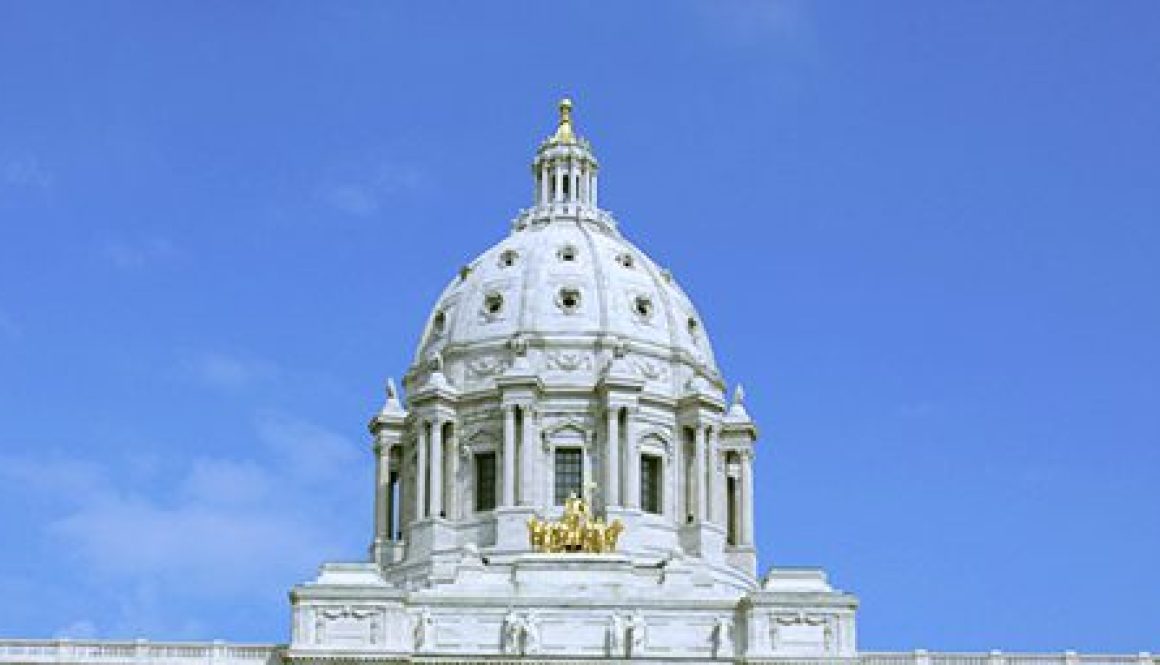
LEGISLATORS RETURN AFTER BREAK, ENTERING FINAL STRETCH
Legislators returned to the Capitol this week following the Easter and Passover break and are now entering the final stretch of the 2026 session. With policy committee deadlines in the rearview mirror and just over a month until the May 18 adjournment, legislators now have a week to finish work on major finance bills ahead of the April 17 deadline. Attention has turned to assembling omnibus bills, though there is still uncertainty about whether agreements on supplemental budget and bonding bills will be reached this year.
BILLS SIGNED INTO LAW
As the session continues, a few bills have been signed into law by Gov. Tim Walz.
HF 3615 (Hanson, J.) extends the deadline for hemp-derived products testing allows lower-potency hemp edibles that don’t contain intoxication cannabinoids to be tested at any recognized laboratory by extending the expired laboratory testing requirements. This measure permits testing through May 31, 2027. This gives businesses more time to use out-of-state testing facilities.
SF 3623 (Johnson-Stewart) mandates that a vehicle must stop whenever a school bus’s red lights flash. irrespective of the extension of the stop signal arm. The law also includes a clause that says a school bus’s flashing amber lights alert any oncoming cars that it is halting and will shortly be flashing red lights.
HF 4541 (Perez-Vega) repeals “Cesar Chavez Day” after recent allegations of abuse committed by Chavez.
HF 3425 (Howard) allocates $9 million of remaining supportive housing program grants to address a funding gap with the federal Continuum of Care program. In late 2025, the Department of Housing and Urban Development (HUD) proposed changes to how funding is prioritized for the Continuum of Care program, raising concerns about whether current participants would continue receiving renewals. Legal challenges followed, and a court ordered HUD to maintain its previously announced funding priorities for 2024–2025. At the state level, Minnesota created a supportive housing program funded by the Minnesota Housing Finance Agency (MHFA).
FRAUD PREVENTION
Addressing fraud in state programs remains a central focus at the legislature, with growing bipartisan support for establishing a new Office of the Inspector General. While details are still being finalized, inclusion of funding in Gov. Walz’s supplemental budget proposal increases the likelihood the measure will get passed.
At the administrative level, Minnesota Management and Budget has launched a new public-facing reporting tool to make it easier to flag suspected fraud across public programs. The site directs users to the appropriate agency based on the type of concern, ranging from public program misuse to consumer fraud.
The rollout comes as legislators continue to discuss oversight efforts, with additional hearings expected on how agencies are implementing recommendations to prevent fraud and improve accountability.
ETHICS COMPLAINTS
House Speaker Lisa Demuth has removed Reps. Elliott Engen (R, Lino Lakes) and Walter Hudson (R, Albertville) from their committee assignments for the rest of the legislative session after Engen was arrested for driving under the influence late last month. Hudson was a passenger in his vehicle.
The House DFL filed an ethics complaint after Engen and Hudson left the House Education Finance committee hearing early to go to a bar, and consumed alcohol before floor session that evening. Under House rules, the complaint would be referred to the House Ethics Committee for review.
Republican House members have filed an ethics complaint against Rep. Alex Falconer (DFL, Eden Prairie) over an alleged conflict of interest related to outside employment with Republicans claiming that Falconer’s actions make him “effectively a legislator lobbyist.”
These ethics complaints must be resolved by the end of session and will add even more tension and political divide to the final stretch of session.
STATE OF THE STATE ADDRESS
Gov. Tim Walz will deliver his 2026 State of the State Address on April 28, 2026, during a joint House and Senate session.
The address will likely outline his final term priorities and will be his final State of the State Address.
IMPORTANT DATES
April 17: Third Committee Deadline
April 28: Gov. Tim Walz’s State of the State Address
May 18: Adjournment of Legislative Session
HELPFUL LINKS TO FOLLOW ACTION AT THE STATE CAPITOL
On March 17, Gov. Tim Walz released his 2026 budget recommendations.
Unlike a biennial budget, which is constitutionally required to pass during every odd-numbered year, this is a supplemental budget, which is optional. As a result, this proposal serves as the governor’s suggested roadmap and starting point for negotiations during the remainder of the legislative session. Here is a one-page summary document and one-page spreadsheet from the governor’s office. A more detailed 42-page “Accounts by Agency”document includes all budget items, as well as policy changes that carry no fiscal impact but remain part of the broader package.
In a press release, the governor’s office said the proposal “prioritizes lowering costs for middle-class families, helping Minnesotans through workforce disruptions caused by artificial intelligence, and responding to Operation Metro Surge, while making responsible cuts to continue Minnesota’s record of balanced budgets.”
An overview of key provisions follows.
Tax Relief & Economic Policy
Expand the Dependent Care Tax Credit by increasing maximum eligible expenses by $3,000 (one child) and $6,000 (two or more children under age 5)
Reduce the statewide sales tax rate by 0.075%, and expand it to include services like accounting, banking, and law
Establish a council to study the future AI economy
Implement a new social media tax on large technology companies
Response to “Operation Metro Surge”
Provide rental assistance for impacted individuals
Offer small business loans to businesses affected by the surge
Create a $10 million emergency fund to respond to future impacts
Public Safety & Gun Policy
Assault weapons ban
Close the “ghost gun” loophole
Enhance State Capitol security
Increase penalties for impersonating a police officer
Expand mental health and school-based safety resources
Fraud Prevention
Increase statewide fraud detection efforts
Modernize outdated IT systems at the Department of Human Services
Expand staffing in the Attorney General’s Medicaid Fraud Unit
The governor’s proposed budget aims to reduce projected state spending by $370 million in fiscal year 2029, cutting the structural deficit by nearly 20%. Under the proposal, the state would maintain an estimated $1.8 billion balance heading into the FY 2028–29 biennium.
The governor also noted the state is projected to carry forward a $3.7 billion balance in the current biennium and nearly $800 million in the next, while acknowledging that “tough choices” are necessary to maintain long-term fiscal stability. Much of his proposed savings come from cuts to long-term care and special education transportation funding.
LEGISLATIVE PATH FORWARD
At this stage, bill language has not yet been released, and all proposals must still move through the legislative process. Legislators are expected to use the governor’s proposal as a framework for negotiations during the last two months of the session.
IMPORTANT DATES
March 27, 2026: First and Second Committee Deadlines
March 27-April 7, 2026: Easter/Passover Break
April 17, 2026: Third Committee Deadline
May 18, 2026: Adjournment of Legislative Session
HELPFUL LINKS TO FOLLOW ACTION AT THE STATE CAPITOL
The newest budget forecast from the Minnesota Department of Budget and Management shows Minnesota’s budget outlook has improved amid significant near-term economic and fiscal uncertainty.
The FY 2026-27 projected balance is now $3.7 billion, $1.3 billion higher than November estimates. A slightly improved economic outlook drives a higher revenue forecast largely driven by more volatile sources of revenue. Spending growth outpaces revenue growth through projections for FY 2029.
The projected general fund balance for the FY 2028-29 biennium is now $377 million; however, a significant structural imbalance remains. Shifting policies at the federal level and missing or incomplete data due to recent federal government shutdowns introduce significant uncertainty to the projections.
This is the last substantial glimpse into state finances lawmakers will get before they ramp up their work in St. Paul.
The full report can be viewed online at the Department of Minnesota Management and Budget.
GOVERNOR INTRODUCES ANTI-FRAUD PROPOSALS
Last week, Gov. Tim Walz presented his proposals aimed at combating fraud in state programs. They focus on three main areas:
Better detection and oversight: A proposal to provide additional funding for the Managed Care Organizations (MCOs) and having staff within DHS dedicated to MCOs oversight. This also includes using technology to detect fraud earlier by using predictive analytics for pre- and post-payment review. Additionally, this includes ending appropriations to legislatively named grantees, with grants awarded through a competitive RFP process. It also proposes to add staff at Minnesota Management and Budget to independently review high-risk audit findings.
Strengthen Investigation and Enforcement Authority: This proposal would expand the Bureau of Criminal Apprehension’s (BCA) Financial Crimes and Fraud Unit and increase the number of investigators focused on Child Care Assistance Program fraud. It would also expand staffing within the Attorney General’s Medicaid Fraud Unit. In addition, the plan would expand the Responsible Contractor Law to disqualify individuals convicted of fraud involving public funds, preventing bad actors from creating new businesses to avoid accountability. The proposal would also expand subpoena authority related to identity theft and financial exploitation, broaden the definition of identity theft to include misuse of a person’s digital likeness, and increase the statute of limitations to seven years for certain financial crimes.
Increased Criminal Penalties: This proposal would increase penalties by 20% compared to existing theft laws and extend the statute of limitations for certain fraud-related crimes to seven years, beginning when fraud is discovered but no later than seven years after the crime occurred.
INDEPENDENT OFFICE OF INSPECTOR GENERAL
The bill to establish an independent Office of Inspector General, a significant proposal for addressing fraud in state programs, passed the Senate with bipartisan support last session, but was not passed by a tied House. While legislators from both sides of the aisle and the governor support the general concept of the proposal, disagreements over specifics are proving to be a hindrance. The proposal has continued to stall in the House this year.
The previously passed Senate version established an independent office with its own law enforcement division, but House Republicans and Democrats are divided on whether the office should have independent investigative authority or rely on the Minnesota Bureau of Criminal Apprehension’s financial crimes unit, with Republicans preferring the former and Democrats the latter.
Additional disputes with the bill involve the appointment of the Inspector General and funding levels for the office. The bill has failed to advance out of committee twice so far this session as negotiations continue.
FEDERAL MEDICAID PAUSE
Last week, Vice President J.D. Vance and CMS Administrator Dr. Mehmet Oz announced that the federal government would pause nearly $260 million in Medicaid payments to Minnesota as part of a crackdown on health care fraud. The state will have 60 days to provide evidence to CMS that Medicaid claims for the 1.2 million Minnesotans on Medicaid from the last quarter of 2025 are all legitimate for the funds to be unfrozen.
PERMANENT DHS COMMISSIONER
It was also announced last week that Interim DHS Commissioner Shireen Gandhi will stay on as permanent DHS Commissioner through the end of Gov. Walz’s term. Commissioner Gandhi took over in an interim capacity after Commissioner Jodi Harpstead, who served as DHS Commissioner for more than five-and-a-half years, resigned in January 2025. Commissioner Gandhi joined DHS in 2017 as Deputy Commissioner overseeing budget and financial operations.
IMPORTANT DATES
March 20, 2026: Eid Break
March 27, 2026: First and Second Committee Deadlines
March 27-April 7, 2026: Easter/Passover Break
April 17, 2026: Third Committee Deadline
May 18, 2026: Adjournment of Legislative Session
HELPFUL LINKS TO FOLLOW ACTION AT THE STATE CAPITOL
The 2026 legislative session convened Tuesday under somber circumstances, marking the first time in 20 years that a session has begun without Speaker Emerita Melissa Hortman. The day was dedicated to remembering Hortman and her husband Mark, and family dog Gilbert, who were assassinated last June.
Sen. John Hoffman (DFL, Champlin) was recognized during Tuesday’s ceremony as well. He and his wife, Yvette, were also targeted that night, but survived and are on the road to recovery.
Members of the House and Senate read a joint resolution honoring Hortman’s legislative accomplishments and reflecting on her family’s life, highlighting her empathy, leadership style, and personal passions. DFL Leader Zack Stephenson (DFL, Coon Rapids) described her as one of the most consequential Speakers in state history. House Speaker Lisa Demuth (R, Cold Spring) spoke about Hortman’s approach to leadership, saying, “Melissa’s brand of leadership brought people in instead of pushing people out.” Gov. Tim Walz reflected on his working relationship with Hortman and described her as a steady presence who brought humor, discipline and decency to her work.
As the ceremony concluded, members placed roses on Hortman’s desk, which will remain as a memorial throughout the session.
The Senate also recognized Sen. Bruce Anderson, who unexpectedly passed away in July.
CAUCUS PRIORITIES
On Monday, Republican and DFL leaders held press conferences to highlight their respective priorities this session.
Speaker Lisa Demuth (R, Cold Spring) and Leader Harry Niska (R, Ramsey), speaking for the Republican caucus, said their focus this year would be on combating fraud, making the state more affordable, and getting a bonding bill passed. HF1, authored by Rep. Patti Anderson (R, Dellwood) proposes to create an independent Office of the Inspector General to investigate state agencies for fraud. This is one of several bills Republicans are introducing to address fraud. To address affordability, they spoke about bills to establish a permanent reinsurance program to lower healthcare costs and a commission to investigate the rise of property taxes.
The DFL leadership focused on responding to the recent immigration enforcement surge in the state that resulted in the killing of two Minnesotans by federal agents. Proposed bills aim to curb the actions of federal agents — like requiring identification, prohibiting masks, staying away from childcare centers and schools, and restricting the use of tear gas and flash bangs, among others. DFL Leader Zack Stephenson (DFL, Coon Rapids) spoke about the opportunity for bipartisan support on this issue.
FEDERAL IMMIGRATION ENFORCEMENT MEASURE HEARD IN HOUSE EDUCATION POLICY COMMITTEE
The first bill addressing federal immigration enforcement in the state was heard in the House Education Policy committee on Wednesday. HF 3435, authored by Rep. Sydney Jordan (DFL, Minneapolis) would prevent federal agents from entering schools without providing identification, a statement of purpose, judicial warrant, and approval from a district’s superintendent. Under these conditions, agents would be restricted from areas of the school where students are present. The bill failed to pass out of committee on a 7-7 party line vote. Rep. Peggy Bennet (R, Albert Lea) said it is not fair to shift responsibility to schools, and that the solution is cooperation from state and local government so federal agents leave.
WEAPONS SCREENING AT THE CAPITOL
New security measures are now in place at the Capitol. Weapons screening checkpoints have been added at four entrances to the building. The screening technology detects potential threats and does not require visitors to remove jackets, shoes, or belts, and is safe for individuals with medical devices such as pacemakers.
The primary public entrances are the main doors beneath the Capitol steps. Additional screening locations are at the main entrance to the Minnesota Senate Building, the underground tunnels connecting to the Senate Building to the State capitol and in the tunnel between the Judicial Center and the State Capitol.
Individuals with conceal carry permits may still bring firearms into the Capitol — but must present both their permit and a valid ID during the screening process. Legislators are exempt from screening.
BUDGET
Minnesota Management and Budget (MMB) reported that January tax collections came in $513 million above projections, which is 17 percent higher than anticipated. This is the last revenue report before the release of the February budget forecast that will outline the larger picture of the state’s fiscal situation. The individual income tax was the main reason for this variance, at $479 million more than previous projections. Corporate and sales taxes remained steady. MMB officials caution that monthly revenue reports can fluctuate and should not be viewed as definitive indicators of long-term trends.
IMPORTANT DATES
March 20, 2026: Eid Break
March 27, 2026: First and Second Committee Deadlines
March 27-April 7, 2026: Easter/Passover Break
April 17, 2026: Third Committee Deadline
May 18, 2026: Adjournment of Legislative Session
HELPFUL LINKS TO FOLLOW ACTION AT THE STATE CAPITOL