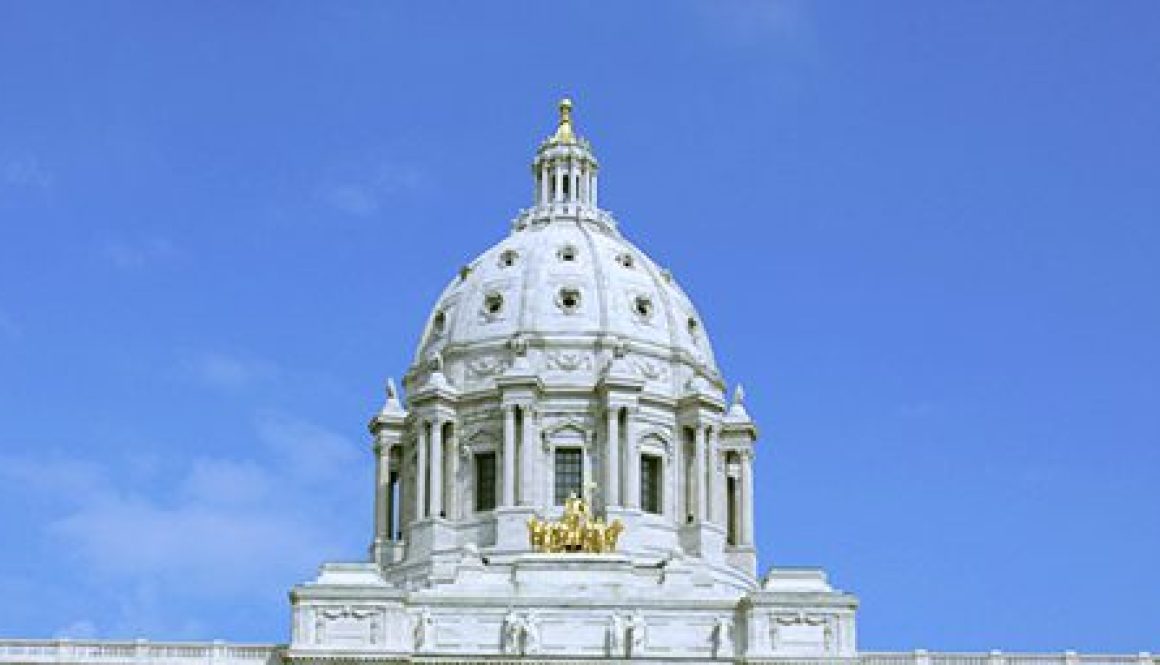
The 2026 legislative session convened Tuesday under somber circumstances, marking the first time in 20 years that a session has begun without Speaker Emerita Melissa Hortman. The day was dedicated to remembering Hortman and her husband Mark, and family dog Gilbert, who were assassinated last June.
Sen. John Hoffman (DFL, Champlin) was recognized during Tuesday’s ceremony as well. He and his wife, Yvette, were also targeted that night, but survived and are on the road to recovery.
Members of the House and Senate read a joint resolution honoring Hortman’s legislative accomplishments and reflecting on her family’s life, highlighting her empathy, leadership style, and personal passions. DFL Leader Zack Stephenson (DFL, Coon Rapids) described her as one of the most consequential Speakers in state history. House Speaker Lisa Demuth (R, Cold Spring) spoke about Hortman’s approach to leadership, saying, “Melissa’s brand of leadership brought people in instead of pushing people out.” Gov. Tim Walz reflected on his working relationship with Hortman and described her as a steady presence who brought humor, discipline and decency to her work.
As the ceremony concluded, members placed roses on Hortman’s desk, which will remain as a memorial throughout the session.
The Senate also recognized Sen. Bruce Anderson, who unexpectedly passed away in July.
CAUCUS PRIORITIES
On Monday, Republican and DFL leaders held press conferences to highlight their respective priorities this session.
Speaker Lisa Demuth (R, Cold Spring) and Leader Harry Niska (R, Ramsey), speaking for the Republican caucus, said their focus this year would be on combating fraud, making the state more affordable, and getting a bonding bill passed. HF1, authored by Rep. Patti Anderson (R, Dellwood) proposes to create an independent Office of the Inspector General to investigate state agencies for fraud. This is one of several bills Republicans are introducing to address fraud. To address affordability, they spoke about bills to establish a permanent reinsurance program to lower healthcare costs and a commission to investigate the rise of property taxes.
The DFL leadership focused on responding to the recent immigration enforcement surge in the state that resulted in the killing of two Minnesotans by federal agents. Proposed bills aim to curb the actions of federal agents — like requiring identification, prohibiting masks, staying away from childcare centers and schools, and restricting the use of tear gas and flash bangs, among others. DFL Leader Zack Stephenson (DFL, Coon Rapids) spoke about the opportunity for bipartisan support on this issue.
FEDERAL IMMIGRATION ENFORCEMENT MEASURE HEARD IN HOUSE EDUCATION POLICY COMMITTEE
The first bill addressing federal immigration enforcement in the state was heard in the House Education Policy committee on Wednesday. HF 3435, authored by Rep. Sydney Jordan (DFL, Minneapolis) would prevent federal agents from entering schools without providing identification, a statement of purpose, judicial warrant, and approval from a district’s superintendent. Under these conditions, agents would be restricted from areas of the school where students are present. The bill failed to pass out of committee on a 7-7 party line vote. Rep. Peggy Bennet (R, Albert Lea) said it is not fair to shift responsibility to schools, and that the solution is cooperation from state and local government so federal agents leave.
WEAPONS SCREENING AT THE CAPITOL
New security measures are now in place at the Capitol. Weapons screening checkpoints have been added at four entrances to the building. The screening technology detects potential threats and does not require visitors to remove jackets, shoes, or belts, and is safe for individuals with medical devices such as pacemakers.
The primary public entrances are the main doors beneath the Capitol steps. Additional screening locations are at the main entrance to the Minnesota Senate Building, the underground tunnels connecting to the Senate Building to the State capitol and in the tunnel between the Judicial Center and the State Capitol.
Individuals with conceal carry permits may still bring firearms into the Capitol — but must present both their permit and a valid ID during the screening process. Legislators are exempt from screening.
BUDGET
Minnesota Management and Budget (MMB) reported that January tax collections came in $513 million above projections, which is 17 percent higher than anticipated. This is the last revenue report before the release of the February budget forecast that will outline the larger picture of the state’s fiscal situation. The individual income tax was the main reason for this variance, at $479 million more than previous projections. Corporate and sales taxes remained steady. MMB officials caution that monthly revenue reports can fluctuate and should not be viewed as definitive indicators of long-term trends.
IMPORTANT DATES
March 20, 2026: Eid Break
March 27, 2026: First and Second Committee Deadlines
March 27-April 7, 2026: Easter/Passover Break
April 17, 2026: Third Committee Deadline
May 18, 2026: Adjournment of Legislative Session
HELPFUL LINKS TO FOLLOW ACTION AT THE STATE CAPITOL
The 2026 Legislative Session officially begins on February 17, less than two weeks away. Starting Monday, the House can start to prefile bills, which means House members can get bills dropped into the hopper — they will be formally introduced on the first day of session. Committees in both the House and Senate can start meeting, and legislative action will begin. With a tied House and narrow 34-33 DFL majority in the Senate, bipartisan cooperation will be needed to get anything passed this session. Potential issues the legislature will discuss include:
Public safety and safety at the Capitol.
Fraud, waste and abuse.
Responding to federal government budget cuts and freezes for low-income support programs.
KLOBUCHAR ANNOUNCES CANDIDACY FOR GOVERNOR
After Gov. Tim Walz’s decision not to seek reelection, U.S. Sen. Amy Klobuchar announced that she is entering the race for Minnesota governor. Klobuchar, elected in 2006, is currently serving her fourth term as Minnesota’s senior U.S. senator.
In her campaign announcement video, Klobuchar said, “These times call for leaders who can stand up… who are also willing to find common ground and fix things.”
Klobuchar was the first woman elected to the U.S. Senate from Minnesota. A lifelong Minnesotan, she is the granddaughter of a miner, the daughter of a sports journalist and a teacher, and was born in Plymouth. Prior to serving in the U.S. Senate, she was the Hennepin County Attorney. Klobuchar brings significant statewide name recognition and has already received endorsements from several state leaders.
Republican leaders have also responded to her entry. Minnesota House Speaker and Republican gubernatorial candidate Lisa Demuth said Klobuchar “cannot deliver the change that our state needs” and characterized her candidacy as a continuation of the Walz administration. Critics have also raised questions about how Klobuchar would address fraud in state programs.
Klobuchar’s entry reshapes the 2026 gubernatorial field and raises additional questions, including how the open Senate seat would be filled if she is elected governor. Under Minnesota law, the governor would appoint a temporary replacement until a special election is held to fill the remainder of her term.
SPECIAL ELECTIONS
Last week, two special elections were held to fill vacant House seats in District 64A and 47A. 64A was previously held by St. Paul Mayor Kaohly Her, vacant since she was elected mayor last fall. The race was won by DFL candidate Meg Luger-Nikolai with 95.28% of the vote. 47A has been vacant since Sen. Amanda Hemmingsen-Jaeger resigned to take her seat in the state Senate. The seat was won by DFL candidate Shelley Buck, running unopposed.
With the DFL retaining both seats, the House will remain at a 67-67 tie going into the 2026 legislative session.
CAUCUSES AND POLLS
Minnesota politics has always been local. It has also been the focal point of national news in recent months; something that Minnesotans certainly felt as they turned out in droves for precinct caucus night on Tuesday to make their voices heard on their preferred candidates. Republican caucus turnout was around 18,000 voters, while the DFL reported turnout was around 30,000.
The caucus straw polls, while not binding, give us a better picture of what the governor’s race may look like this year. U.S. Sen. Amy Klobuchar solidified her position as the DFL nominee with 79% of the vote. 16% were uncommitted and the rest backed other candidates.
Speaker Lisa Demuth received the most support in the Republican caucus with 32%, followed by businessman Kendall Qualls at 25% and MyPillow founder Mike Lindell at 18%. No other candidate exceeded 1,000 votes.
In addition to the caucus results, a recent KSTP poll indicates that voters have not yet decided who they prefer in the U.S. Senate race. On the DFL side, the largest share of respondents, 26%, said they were undecided. Among named candidates, Rep. Angie Craig received 20%, followed by Lt. Gov. Peggy Flanagan at 19%. Former broadcaster Michele Tafoya led Republican candidates at 13%. Other respondents selected former Senate candidate Royce White with 7%, and Tom Weiler with 5%.
WEAPONS SCREENING
The Senate (SP 8.50) and Governor’s Office (EO 26-02) have implemented new policies regarding weapons screening at the Capitol Complex. There will be weapons screening at entrances to the Capitol and Senate Building, with locations to be designated by the Rules committee. Those with a Permit to Carry will be asked to show their permit upon screening and will be allowed to carry inside both areas. Permit holders will not be allowed to carry in the Senate gallery, however.
RETIREMENTS
The list of legislative retirements continues to grow. Recently, long-serving Republicans Sen. Warren Limmer (the longest-serving Republican senator), Sen. Gary Dahms and Rep. Paul Torkelson all announced they will not seek reelection. On the DFL side, Senator Tou Xiong announced last month that he will retire as well. You can view the list of previous retirement announcements here.
IMPORTANT DATES
Feb. 17, 2026: Start of Legislative Session
March 20, 2026: Eid Break
March 27, 2026: First and Second Committee Deadlines
March 27-April 7, 2026: Easter/Passover Break
April 17, 2026: Third Committee Deadline
May 18, 2026: Adjournment of Legislative Session
EWALD GOVERNMENT RELATIONS TOOLKIT
The Ewald Government Relations team is sharing content along with our updates to help you better understand the legislative process and how to engage effectively. From decoding how the Legislature works to learning how to advocate for your priorities, these resources are designed to support your advocacy every step of the way.
This week’s article provides an overview on what to expect when meeting with legislators.
Engaging with government can feel intimidating. The process can be complex and difficult to navigate. However, advocacy is a vital part of shaping policies that impact you and your organization. Your voice matters!
In a new short video (less than 5 minutes), our team shares practical advocacy tips to help you communicate your priorities, build strong relationships with legislators, and make a real impact throughout the legislative session and beyond.
Gov. Tim Walz announced Monday that he will not seek a third term in office, ending his reelection campaign and shaking up the 2026 gubernatorial race. Walz said he made the decision so he could focus his remaining time as governor on issues including addressing fraud in state programs rather than running a political campaign, saying, “Every minute that I spend defending my own political interest would be a minute I can’t spend defending the people of Minnesota against the criminals who prey on our generosity and the cynics who want to prey on our differences. So I’ve decided to step out of this race, and I’ll let others worry about the election.” His announcement follows increased attention in recent months on fraud allegations in Minnesota’s state programs. Walz, a former teacher and member of Congress who later rose to national prominence as the 2024 Democratic vice-presidential nominee, did not announce future plans.
Walz’s decision opens the field for new candidates on the Democratic side. Potential Democratic contenders are now being discussed, including U.S. Sen. Amy Klobuchar, who has said she is considering a run.
Several Republicans have already entered the race, including House Speaker Lisa Demuth, Rep. Kristin Robbins, Kendall Qualls, and MyPillow founder Mike Lindell. 2022 Republican nominee former state senator Scott Jensen is also running.
Responses to Walz’s announcement largely reflected party divisions, with Democratic leaders highlighting his leadership and Republicans criticizing his record, particularly the fraud allegations.
NEW LAWS
Several new Minnesota laws take effect with the new year, introducing changes that affect employment, elections, public safety, and natural resources.
Among the most significant is the implementation of the state’s paid family and medical leave program, which allows eligible employees to take up to 12 weeks of paid leave for their own serious health condition or to care for a family member, and up to 12 weeks for the birth or adoption of a child, with a maximum of 20 weeks per year. Benefits will replace a portion of wages based on income, and the program will be funded through a payroll tax.
Additional new laws address election procedures, workplace standards, and insurance premium fraud prevention. Beginning in 2026, online absentee ballot applications will require expanded identification information, and new disclaimers will be required on non-government election mailings. Workplace laws will establish minimum requirements for rest and meal breaks, while changes to workers’ compensation rules aim to reduce fraud in the construction industry.
Other updates include allowing deer hunters additional firearm choices, revised watercraft surcharges and water-use permit fees, and a new legal process that allows courts to issue protective orders to help prevent the financial exploitation of vulnerable adults.
RURAL HEALTH TRANSFORMATION PROGRAM FUNDING
Minnesota has been awarded more than $193 million in first-year funding through the federal Rural Health Transformation Program to support health care delivery in rural communities across the state. The funding, provided by the Centers for Medicare & Medicaid Services, will support investments in technology, help improve outcomes for chronic conditions such as heart disease and diabetes, grow the rural health care workforce, and enhance the financial stability of rural providers. State health officials said the investment comes at a critical time for rural Minnesota and reflects extensive collaboration with local stakeholders, health systems, Tribes, and public health partners, with implementation expected to begin in early 2026. The federal Rural Health Transformation Program, included in H.R.1, allocates up to $50 billion nationwide over five years to offer support for rural communities impacted by a $137 billion reduction in federal Medicaid spending. More information can be found on the Minnesota Department of Health’s website.
TRUMP ADMINISTRATION WITHHOLDING FEDERAL FUNDS
On Tuesday, the Trump administration said it is withholding federal funding for several social safety net programs, including the Child Care Development Block Grant, Temporary Assistance for Needy Families, and the Social Services Block Grant, citing concerns about fraud. The administration has not released details of the claims yet, but alleges that California, Colorado, Illinois, Minnesota, and New York have improperly directed funds to people in the country illegally. Federal childcare assistance to Minnesota was suspended last month amid probes into suspected fraudulent activity at day care facilities. Minnesota has been facing snowballing reports of fraud in state programs, mostly notably in the Feeding Our Future case.
IMPORTANT DATES
Jan. 27, 2026: Special Election for House Districts 47A and 64A
Feb. 17, 2026: Start of Legislative Session
March 20, 2026 – Eid Break
March 27, 2026 – First and Second Committee Deadlines
March 27-April 7, 2026 – Easter/Passover Break
April 17, 2026 – Third Committee Deadline
May 18, 2026: Adjournment of Legislative Session
EWALD GOVERNMENT RELATIONS TOOLKIT
We are sharing content along with our updates to help you better understand the legislative process and how to engage effectively. From decoding how the Legislature works to learning how to advocate for your priorities, these resources are designed to support your advocacy every step of the way.
This week’s article provides an overview of how to testify at committee hearings.
On Dec. 4, Minnesota Management and Budget (MMB) released the November budget and economic forecast, the first look into the state’s fiscal health before the 2026 Legislative Session. The forecast showed that Minnesota is on a solid fiscal footing for the current budget cycle. This is largely due to higher revenue than expected throughout the fiscal year and a favorable year-end financial close, which leaves the state with an expected $2.465 billion surplus in the current biennium. Longer-term projections, however, are less favorable. Rising costs in the health care sector and expected sluggish economic growth are putting pressure on the state’s outlook, leading to an anticipated $2.960 billion budget shortfall in the FY 2028–29 biennium. Despite these future challenges, the state’s general fund reserves remain robust, holding steady at the statutory level of $3.771 billion.
During a press conference on Thursday, Gov. Tim Walz and legislative leadership spoke about the new budget forecast. Gov. Walz and DFL leadership emphasized that Minnesota’s financial position remains strong, with a budget surplus, reserves, and economic growth outpacing much of the country; results they attributed to responsible budgeting. They said the negative outlook is a product of national economic trends resulting from changes at the federal level — including HR1, which Congress passed this summer. Republican leaders criticized the budget outlook, saying the projected deficits come from excessive spending during the DFL trifecta and inadequate oversight of fraud by the Walz administration. Several questions were asked about the impact of fraud on the forecast, which MMB representatives said is not factored into the forecast. Both sides spoke on the fiscal restraints they face going into the 2026 session, and the importance of addressing fraud in state programs.
Gov. Walz and legislators will use the November Forecast to develop potential budget proposals for a supplemental budget. The legislature is not constitutionally required to enact a supplemental budget, even with a budget surplus.
SHIFTING POLITICAL LANDSCAPE
The legislative landscape has shifted significantly this year due to special elections, retirements, and 2026 candidacies. Following is a summary of the developments so far.
Sen. Matt Klein (DFL, Mendota Heights), Sen. Eric Pratt (R, Prior Lake) and Rep. Kaela Berg (DFL, Burnsville) are running for the Second Congressional District seat — which is currently held by U.S. Rep. Angie Craig, who is running for U.S. Senate.
Speaker Lisa Demuth (R, Cold Spring) and Rep. Kristin Robbins (R, Maple Grove) will vie for the Republican nomination for governor. Rep. Heather Keeler (DFL, Moorhead) is running for the Seventh Congressional District. Rep. Elliott Engen (R, White Bear Township) and Rep. Dan Wolgamott (DFL, St. Cloud) are running for State Auditor. Lastly, Rep. Cedrick Frazier (DFL, New Hope) is running for Hennepin County Attorney.
The list of legislative retirements continues to grow with the recent retirement announcements of Sen. Alice Mann (DFL-Edina) and Rep. Tim O’Driscoll (R, Sartell). Previously announced retirements include Sen. Steve Cwodzinski (DFL, Eden Prairie), Sen. Rich Draheim (R, Madison Lake), Sen. Jeff Howe (R, Rockville), Rep. Sandra Feist (DFL, New Brighton), Rep. Erin Koegel (DFL, Spring Lake Park), Sen. Sandy Pappas (DFL, St. Paul), Sen. Jim Carlson (DFL, Eagan), Sen. Ann Rest (DFL, New Hope), Sen. Jeremy Miller (R, Winona), Rep. Kelly Moller (DFL, Shoreview) and Rep. Ron Kresha (R, Little Falls).
Legislative retirements and changes can be found here.
Two special elections to fill vacant House seats in Districts 47A and 64A will take place on Jan. 27, 2026, following writs issued by Gov. Walz. The seats became vacant when Reps. Amanda Hemmingsen-Jaeger and Kaohly Vang Her resigned to assume new roles: Hemmingsen-Jaeger after winning a special election to the state Senate, and Her after being elected mayor of St. Paul. The balance of power in the House will remain an even 67–67 split if Democrats hold both seats when the Legislature returns on Feb. 17. Primaries will be held on Dec. 16.
There have also been committee leadership changes. Rep. Erin Koegel (DFL, Spring Lake Park) will be co-chair of the House Commerce Finance and Policy Committee following the resignation of Rep. Kaohly Her. Rep. Koegel served as co-chair of the House Transportation Committee, and will be succeeded in that role by Rep. Brad Tabke (DFL, Shakopee).
HOUSE RESEARCH OVERVIEWS
The Minnesota House Research Department provides nonpartisan and neutral research to legislators, staff, and the public. They recently published an updated overview of Minnesota’s Medical Assistance Program, which includes summaries of eligibility requirements, benefits, funding, and program spending. You can find the report here: Medical Assistance.
House Research also published a guide for School Finance in Minnesota, aimed at educating legislators. This report can be found here: School Finance.
IMPORTANT DATES
Dec. 16, 2025: Special Primary Elections for Districts 47A and 64A
Jan. 27, 2026: Special Election for House Districts 47A and 64A
Feb. 17, 2026: Start of Legislative Session
May 18, 2026: Adjournment of Legislative Session
EWALD GOVERNMENT RELATIONS TOOLKIT
We are sharing content along with our updates to help you better understand the legislative process and how to engage effectively. From decoding how the Legislature works to learning how to advocate for your priorities, these resources are designed to support your advocacy every step of the way.
This week’s article provides a basic overview of how the State Legislature functions.
Tuesday was election day, and Minnesota voters went to the polls to decide several significant races.
Amanda Hemmingsen-Jaeger won Senate District 47, the seat left vacant after the felony burglary conviction and subsequent resignation of former Sen. Nicole Mitchell. The district covers parts of Woodbury and Maplewood, and Hemmingsen-Jaeger won with 61.74% of the vote over Republican Dwight Dorau’s 38.26%. In Senate District 29, Michael Holmstrom won the seat previously held by late Sen. Bruce Anderson, defeating DFL candidate Louis McNutt 62.3% to 37.7%. These outcomes return the Minnesota Senate to a narrow 34–33 DFL majority.
In municipal news, Rep. Kaohly Her will be the next mayor of St. Paul, defeating incumbent Melvin Carter and making history as the first woman and first person of Hmong descent to hold the office. In Minneapolis, incumbent Mayor Jacob Frey defeated Sen. Omar Fateh.
The wins by Reps. Her and Hemmingsen-Jaeger will create two vacancies in the state House. Gov. Walz said he anticipates calling for special elections later this month, with primaries being held on Dec. 16 and special elections on Jan. 27.
SPEAKER DEMUTH RUNNING FOR GOVERNOR
Over the weekend, Republican House Speaker Lisa Demuth officially announced her candidacy for governor. Demuth is the most senior Republican to enter the race so far, joining a crowded field that already includes Rep. Kristin Robbins, former GOP nominee Scott Jensen, and businessman Kendall Qualls. Several candidates have indicated they will run in a primary if they do not win the endorsement.
If she secures the Republican nomination and wins a potential primary, Demuth will face Gov. Tim Walz, who is seeking a third term. Her entry adds a new dynamic to the race, not only because of her position as Speaker, but also because she leads a closely divided House, where both parties currently hold an equal number of seats. How she balances the demands of governing while running a statewide campaign will be closely watched in the months ahead.
BUDGET UPDATE
Minnesota wrapped up its 2024–25 budget year with a stronger financial position than expected, posting a $941 million surplus. The state’s financial report from the Department of Minnesota Management and Budget shows revenues $1.3 billion higher than projected, while expenses were about $364 million above estimates.
The unexpected boost came mainly from higher tax receipts, and funds returned from projects or programs that didn’t use their full budgets. On the spending side, most of the increase was tied to education, as public schools enrolled about 1,800 more students than forecast and faced slightly higher special education costs.
This surplus gives lawmakers more flexibility going into an election year, possibly funding construction projects with cash or reducing debt, while also providing a buffer against potential future deficits. Two years ago, the state also finished ahead of projections by roughly $820 million.
Lawmakers will get a more refined understanding of the state’s economic situation in early December when the November forecast is released.
SPECIAL SESSION UNLIKELY
Last month, Gov. Walz walked back his commitment to call a special legislative session on gun restrictions, saying he would only do so if there’s an agreement among legislative leaders. The DFL governor, who previously vowed to reconvene lawmakers regardless of a deal, now says a session without bipartisan cooperation would be “a waste of money and time.”
Calls for a special session on gun violence came after the horrific shooting at Annunciation Catholic School in Minneapolis this summer. The divided legislature leaves neither party with enough votes to pass legislation without bipartisan support, which has proven difficult due to a significant difference in philosophies between Democrats and Republicans at the Capitol. It can be expected that these issues will surface during the 2026 Legislative Session, which convenes on Feb. 17, 2026.
LEGISLATIVE RETIREMENTS
The list of legislative retirements continues to grow, as Rep. Ron Kresha (R, Little Falls) announced last week that he will not seek reelection. His announcement comes in the wake of a lawsuit filed by conservative activists over claims that he committed fraud on applications for Paycheck Protection Program loans during the COVID-19 pandemic. This week, Sen. Sandy Pappas (DFL, St. Paul) also announced she will not be seeking reelection after more than four decades in state government.
Rep. Kresha and Sen. Pappas join a list of retirements this year that includes Sen. Jim Carlson (DFL, Eagan), Jeremy Miller (R, Winona), Rep. Kelly Moller (DFL, Shoreview), and Sen. Ann Rest (DFL, New Hope).
Legislative retirements and changes can be found here.
EWALD GOVERNMENT RELATIONS TOOLKIT
We are sharing content along with our updates to help you better understand the legislative process and how to engage effectively. From decoding how the Legislature works to learning how to advocate for your priorities, these resources are designed to support your advocacy every step of the way.
This week’s articles outline how to find information at the Capitol and how the bonding process works.
Xp Lee Wins Special Election, Restores Tie in Minnesota House
DFLer Xp Lee won the 34B (Brooklyn Park, Champlin, Coon Rapids) special election on Tuesday to fill the seat of late Speaker Emerita Melissa Hortman, securing 60.82% of the vote to 39.11% for Republican Ruth Bittner. Lee is a former Brooklyn Park City Council member and health equity analyst, born in a refugee camp in Thailand.
His win restores the Minnesota House of Representatives to a 67-67 tie between the DFL and Republicans, preserving a power sharing agreement crafted in 2025 after election results left neither party in full control. Under that deal, committee leadership and many legislative processes are split evenly or require bipartisan cooperation.
Lee has pledged to “work hard every day” to carry forward Hortman’s legacy and campaigned on priorities like education, healthcare access, and infrastructure.
Walz Running for 3rd Term
On Tuesday, Gov. Tim Walz ended months of speculation and announced he is running for a third term in 2026. In a video posted online, Walz outlined his priorities if reelected — including combating fraud in state government, making health care more affordable, investing in public education and addressing gun violence.
On the Republican side, three candidates have declared their campaigns for governor: 2022 Republican nominee Dr. Scott Jensen, businessman Kendall Qualls, and State Representative Kristin Robbins, who currently chairs the newly formed House committee on fraud prevention.
If reelected, Walz would become the first governor in state history to win three consecutive terms. Gov. Walz has not announced his running mate. Current Lt. Gov. Peggy Flanagan is running for the United States Senate seat being vacated by U.S. Senator Tina Smith.
Minnesota Receives Top Credit Rating
Gov. Walz announced that Minnesota has once again earned a AAA credit rating from all three major credit agencies (Moody’s, S&P Global Ratings and Fitch) marking the fourth consecutive year the state has received the highest possible rating. This rating reflects continued confidence in Minnesota’s fiscal management, economic performance and budgeting practices.
The governor emphasized that, despite economic uncertainty at the federal level, Minnesota’s financial outlook remains strong due to balanced budgets, protected reserves and long-term investments. “These ratings are a testament to the strength of Minnesota’s economy and our commitment to responsible financial stewardship,” Walz said.
Minnesota is one of only 16 states to currently hold a AAA rating from all three agencies. Minnesota Management and Budget Commissioner Erin Campbell credited the bipartisan effort it took to maintain fiscal discipline, especially during a year that required tough budget decisions and compromise from the nation’s most closely divided legislature.
Each agency praised different aspects of the state’s financial health. Moody’s cited high fund balances and financial flexibility, while Fitch highlighted Minnesota’s diverse economy, educated workforce and low long-term liabilities. S&P Global noted the state’s strong management practices, solid reserves and conservative debt profile.
Executive Order to Address Fraud in State Programs
Gov. Walz issued Executive Order 25-10 to strengthen Minnesota’s ability to prevent, detect, and respond to fraud in state programs. The order emphasizes protecting taxpayer dollars, ensuring public programs serve those most in need, and building public trust in government. It provides direction to several state agencies and takes effect 15 days after publication in the state register.
The Department of Human Services (DHS) is tasked with increasing transparency by publishing program integrity actions, implementing a data-driven post-payment review system for Medicaid claims and identifying high-risk programs for potential reform or closure. DHS will also apply stricter licensing controls, track provider payments through unique identifiers, conduct pre-payment reviews for high-risk claims and disenroll inactive Medicaid providers. Additionally, DHS will modernize fraud prevention systems and seek federal resources and expert support.
The Department of Public Safety (DPS) will lead the formation of a Statewide Inspector General Coordinating Council to bring together agency investigators and internal control staff. DPS will facilitate data-sharing, trend analysis and best practices across agencies, expand access to investigative support and collaborate with the Attorney General’s Office on Medicaid fraud cases.
Minnesota Management & Budget (MMB) will focus on building a statewide culture of fraud prevention by developing standards for employee training, strengthening program integrity career paths and requiring ethics and fraud prevention training for all state employees.
Minnesota IT Services will enhance fraud detection by providing data analytics and technology support. All state agencies are directed to collect and analyze data to prevent fraud and refer suspected cases to appropriate enforcement authorities.
Minnesota Sees Job Growth in August
Minnesota added 5,900 jobs in August, showing stronger growth than the flat national employment trend, according to new data from the Department of Employment and Economic Development (DEED). The state also added nearly 1,100 workers to its labor force, while the unemployment rate ticked up slightly to 3.6%, which is still below the national rate of 4.3%.
Over the past year, Minnesota has gained more than 39,000 jobs, a 1.3% increase that outpaces the national growth rate of 0.8%. Private sector growth was even stronger at 1.4%. Construction, education, and health services led August job gains, while government and manufacturing saw losses.
Early Voting Starts Today
In local communities around Minnesota, early voting starts today (Friday, September 19) for general elections on Tuesday, November 4.
This includes early voting for two state senate seats that are currently vacant:
SD 29, previously held by Sen. Bruce Anderson (who passed away this summer), includes much of Wright County and parts of Meeker and Hennepin Counties. The candidates are Republican Michael Holmstrom, Jr., and DFLer Louis McNutt.
SD 47, previously held by Sen. Nicole Mitchell (who resigned this summer), includes parts of Washington and Ramsey Counties. The candidates are DFLer Rep. Amanda Hemmingsen-Jaeger and Republican Dwight Dorau.
Ewald Consulting Government Relations Toolkit
We are sharing content to help you better understand the legislative process and how to engage effectively. From decoding how the Legislature works to learning how to advocate for your priorities, these resources are designed to support your advocacy every step of the way.
This week’s article outlines what to expect when meeting with legislators.
Gov. Tim Walz met with legislative leaders this week to discuss a potential special session on gun violence, following the horrific shooting at Annunciation Catholic Church in Minneapolis.
Because the legislature is evenly split along party lines, bipartisan support will be necessary to pass any legislation. This may prove to difficult due to differing policy priorities. Many Democrats support banning assault-style and semi-automatic firearms, while Republicans have proposed increasing funding for school safety and mental health resources and repealing Minnesota’s ban on conversion therapy.
Typically, agreements on which bills will be passed are made between the governor and legislative leaders before a special session is called. However, Gov. Walz stated he’s willing to move forward regardless, saying, “I will call a special session one way or another. Just have the hope. Just bring it up. Have the discussion … Maybe it doesn’t pass because the numbers aren’t there, but at least we’re going to know.”
Speaker of the House Lisa Demuth has said, “What we are looking for is bipartisan solutions that will make a difference, will keep kids and Minnesotans safer, and those are the things we want to work on. We have to have continued conversations and explore the root causes of why things happen. Not just doing a knee-jerk reaction.”
House Democrats Select New Leader
On Sept. 8, House Democrats selected Rep. Zack Stephenson (DFL-Coon Rapids) as their next caucus leader. The leadership of House Democrats has been vacant since the tragic assassination of Speaker Emerita Melissa Hortman and her husband Mark in June. Stephenson, now in his fourth term, co-chairs the House Ways and Means Committee and serves on the Taxes and Commerce committees.
Senate Democrats Announce New Subcommittee
Senate Democrats announced this week they are forming the Select Subcommittee on Federal Impacts on Minnesotans and Economic Stability to determine the impacts of the federal budget bill passed by Congress this summer.
Changes from the bill include tax cuts, reductions to Medicaid spending, and increased funding for Immigrations and Customs Enforcement. Chaired by Sen. Lindsey Port, the committee will begin meeting weekly on September 18, alternating between the Capitol and affected communities across the state.
Sen. Erin Murphy, during the announcement on Tuesday, said, “We think it’s important for us to understand from a budget perspective, what the Congress has done, but more importantly, we need to prepare, and help Minnesotans prepare, for what could be a hard economic hit and a lack of stability.”
The committee will be made up of five Democrats and four Republicans.
Senator Miller Announces Retirement
Sen. Jeremy Miller (R-Winona) announced he will not seek re-election next year. Miller, who previously served as Senate President and Majority Leader, was first elected in 2010 at age 26, making him the second-youngest person ever elected to the Minnesota Senate.
Throughout his tenure, he received multiple legislative awards, including Legislator of the Year and Outstanding Support for People with Disabilities. After retiring, he plans to focus on family, community service, and his businesses, though he said he won’t rule out running for public office in the future.
Other legislative retirements and changes can be found here.
State Budget Update
The August Revenue and Economic Update from Minnesota Management and Budget (MMB) showed the state’s general fund revenues totaled $2.1 billion in August, $86 million, or 4.2% above the February forecast. This is due to income and sales tax collection exceeding prior expectations.
A more complete picture of state finances will be available in the October Revenue and Economic Update, which will include data from July through September.
State Fair Poll Results
The nonpartisan House Public Information Services Office and the Senate counterpart conducted their annual State Fair Polls to gauge where Minnesotans stand on key issues. It should be noted that this is not a scientific poll. Here are the responses for some prominent issues:
Guns at the Capitol: 78.9% of respondents support banning guns at the State Capitol.
Undocumented Immigrants: 66% believe undocumented immigrants should have access to state programs. This comes after legislation passed last session ending their access to MinnesotaCare.
School Start Dates: Only 39.9% support allowing school districts to permanently begin classes before Labor Day — a slight decline from previous polls.
Sports Stadium Funding: 69% oppose using state funds to build professional sports stadiums.
Fraud Oversight: 62% support creating a new state agency dedicated to investigating fraud, waste, and abuse.
These are not scientific polls and should be viewed for entertainment purposes only.
Ewald Consulting Government Relations Toolkit
We have started sharing content to help you better understand the legislative process and how to engage effectively. From decoding how the Legislature works to learning how to advocate for your priorities, these resources are designed to support your advocacy every step of the way.
This week’s article covers developing and implementing a legislative plan.
Election Updates, Capitol Security, Board of Regents
Special Elections and Campaign Announcements
Minnesota is experiencing considerable political turnover this year, with multiple special elections underway and several high-profile legislators launching campaigns for higher office.
This week, primaries were held for two vacant State Senate seats to be filled in a special election. In Senate District 49, vacant since the unexpected death of Sen. Bruce Anderson, Republican-endorsed candidate Michael Holmstrom secured the nomination. In Senate District 47, empty since the resignation of Sen. Nicole Mitchell, Democratic endorsee Rep. Amanda Hemmingsen-Jaeger won her primary, defeating fellow lawmaker Rep. Ethan Cha. Both special elections are scheduled for November 4.
Another key race is coming up next month. The special election to fill the seat of Speaker Emerita Melissa Hortman, who was tragically assassinated in June, will take place on September 16. That contest will feature Democratic candidate Xp Lee and Republican Ruth Bittner.
More special elections may follow, depending on the outcomes of two upcoming local races this fall that feature sitting legislators. Among them:
Sen. Omar Fateh is running for mayor of Minneapolis. His endorsement by Minneapolis Democrats was revoked last week, after controversy over the convention process.
Rep. Kaohly Her is challenging Mayor Melvin Carter for mayor of St. Paul.
Looking further ahead, the 2026 election cycle is already beginning to take shape. Rep. Kristin Robbins has declared her candidacy for governor, while Rep. Cedrick Frazier has announced his campaign for Hennepin County Attorney.
Sen. Eric Pratt is joining fellow Sen. Matt Klein in running for Congressional District 2, aiming to succeed Rep. Angie Craig, who is launching a bid for the U.S. Senate.
Rep. Ben Bakeberg has entered the race for Sen. Pratt’s current senate seat in SF 54.
Capitol Security
The Advisory Committee on Capitol Security met on August 20 to discuss potential safety upgrades at the Minnesota Capitol in response to the June shootings that claimed the lives of Speaker Emerita Melissa Hortman and her husband and left Sen. John Hoffman and his wife injured.
Chaired by Lt. Gov. Peggy Flanagan, the committee began developing recommendations for the Legislature to consider during the upcoming session. Members received an overview of current safety measures from security staff and discussed possible improvements.
Proposals discussed by members included installing metal detectors, banning firearms on the premises, requiring bag checks, and encouraging cultural shifts such as heightened situational awareness and reducing inflammatory rhetoric. Rep. Jim Nash emphasized that many changes will take time because they need legislative approval. Gov. Tim Walz, while not on the committee, voiced support for reforms that balance public access with enhanced security.
The committee will reconvene next month to continue the discussion. In the meantime, the Department of Public Safety has already implemented several measures, including reducing the number of public entrances, installing alarms on external doors, and hiring additional security officers. A third-party review of Capitol security is also expected later this year to further guide the process.
UMN Board of Regents
Normally the Board of Regents (the University of Minnesota’s governing body) is appointed by the state legislature. However, the legislature failed to fill four vacant seats during the most recent session, so it was left up to Gov. Walz to temporarily fill the vacancies. He appointed four new interim regents this month, which include a former U.S. ambassador to Norway, a former United Nations food aid counselor, a doctoral student and an employee search group executive.
The appointments were not without controversy, having drawn criticism from both Republicans and some progressive Democrats. House Republican Floor Leader Harry Niska expressed concerns that “the seats are being handed out as rewards to campaign donors rather than being filled on merit.” Republicans have also argued that gubernatorial appointments in this situation bypass the Legislature’s constitutional role in selecting regents.
Sen. Omar Fateh, the Democratic chair of the Higher Education committee tasked with recommending candidates for the legislature to approve, criticized the governor for selecting “a handful of wealthy, well-connected lobbyists who worked to shut student voices out of the board.”
State Budget Update
The July Revenue and Economic Update from Minnesota Management and Budget (MMB) showed the state’s general fund revenues totaled $2.194 billion in July, falling $62 million, or 2.8% below the previous forecast in February. Since July marks the first month of Fiscal Year 2026, this shortfall also reflects the fiscal year’s opening performance.
The largest drop came from individual income tax receipts, which were $51 million below projections. Corporate tax collections also fell short by $23 million. On a more positive note, sales tax revenue exceeded expectations by $3 million, and other miscellaneous revenues came in $10 million higher than forecast.
A more complete picture of state finances will be available in the October Revenue and Economic Update, which will include data from July through September.
Ewald Consulting Government Relations Toolkit
Starting this month, we’ll share content to help you better understand the legislative process and how to engage effectively. From decoding how the Legislature works to learning how to advocate for your priorities, these resources are designed to support your advocacy every step of the way.
This week’s articles go over what work in the interim between legislative sessions looks like, and an overview of the legislative rule making process.
Minnesota is on track to have six special elections this year, which would tie the record set in 1994. In addition to the three elections held during the 2025 legislative session, at least three more are coming due to the assassination of Speaker Emerita Melissa Hortman, the unexpected death of Senator Bruce Anderson (SD 29), and Senator Nicole Mitchell’s (SD 47) resignation due to a conviction of felony burglary.
The election for Hortman’s seat in House District 34B (Brooklyn Park, Champlin, Coon Rapids) is scheduled for Sept. 16, with a Democratic primary on Aug. 12. Both Senate special elections will take place on Nov. 4. Current DFL state Representative Ethan Cha has filed to run in SD 47. DFL Representative Amanda Hemmingsen Jaeger has also announced she is running, but has yet to file. Republican Dwight Dorau, who ran for the seat in 2024, has also filed. So far, four Republicans and one DFLer have filed for SD 29. Filing closes for both senate special elections on Aug. 6 at 5 p.m.
More special elections may be necessary if sitting legislators are elected to other offices, including Senator Omar Fateh, who is running for Minneapolis mayor. Additionally, if one of the open state senate seats is filled by a sitting state representative, that would precipitate another special election for the house seat. With a nearly even partisan split in the legislature, these races could affect the balance of power in the next session.
New Laws
Seven new laws go into effect Aug. 1, impacting several areas — including public safety and property rights. Key changes include stronger penalties for repeat impaired drivers by extending the DWI lookback period from 10 to 20 years, lengthening license revocation times, and increasing ignition interlock requirements. Lawmakers also raised the speed limit from 30 to 35 mph for farm equipment and vehicles hauling uncovered trash or debris.
Local governments can now require background checks for applicants seeking to operate adult entertainment or massage businesses. Service dog trainers will receive the same housing access as individuals with disabilities who rely on service animals. This includes full access to housing and exemption from extra pet fees.
The Minnesota Partition Act modernizes the 120-year-old legal framework for selling jointly owned property, clarifying legal procedures and court involvement. In addition, the Office of the Ombudsperson for American Indian Families is now exempt from certain court fees, aligning its privileges with those of tribal representatives. A new law also grants limited confidentiality to conversations within restorative justice programs to promote more open dialogue among participants.
MMB July Update
A recent monthly update from Minnesota Management and Budget (MMB) shows that state revenues are exceeding the previous forecast from February. Net revenues are now estimated to total $31.9 billion, which is 2.7% ($847 million) higher than the February forecast. The increase is primarily due to increased revenue from income taxes. Corporate taxes, sales taxes, and other revenues were below forecast. Despite the additional revenue, the July update anticipates a worse economic outlook than in February, mainly due to slower growth, higher inflation, and higher interest rates. The next major budget update from MMB is expected in late November/early December, which will give us a better idea of the state budget outlook heading into the 2026 legislative session.
Federal Changes Will Impact State Budget
The recent passage of President Donald Trump’s Reconciliation Bill by Congress is expected to have significant impacts on the state budget. The legislation notably includes cuts to Medicaid funding that will add new challenges to the state’s finances, as summarized recently by the MN Department of Human Services. Despite this, Gov. Walz has said that there is no need for another special session this year to address these changes.
New Fraud Investigation Opened
Gov. Walz announced this week that the Department of Human Services (DHS) has paused payments to 50 housing stability providers, resulting from a broader FBI investigation into fraud in Minnesota’s Housing Stabilization Program. This program has received federal attention after the cost, originally projected to be $2.5 million annually, soared to over $100 million last year.
Federal agents have described this as a “massive scheme to defraud” the program, which has offered Medicaid coverage for housing stabilization since 2020. Acting under a new state law, officials now have the authority to suspend funding for up to 60 days when credible evidence of fraud exists. Although the pause may affect some legitimate organizations, Walz emphasized that stricter controls are necessary to close gaps in the system. Additional documentation rules for providers will take effect in August, according to DHS. This case adds to a growing list of investigations of fraud into Minnesota’s state programs — namely Feeding Our Future and autism support centers.